The Integrative HOPE Center of Arizona is a pediatric-focused practice founded by Dr. Shawn K. Centers, MD(H). He completed formal postgraduate medical training in pediatrics at the Children's Hospital of New Jersey, including internship residency, pediatric chief residency, and brings over three decades of clinical experience caring for children. His current practice emphasizes integrative, homeopathic, and whole-person care for children with complex and chronic conditions, with a strong focus on accessible healthcare for children with special needs including telehealth services.
When other doctors said there was little hope, these families found it.
The Integrative HOPE Center of Arizona helps children with autism, seizures, PANS/PANDAS, ADHD, and complex developmental conditions — when conventional approaches haven’t worked. Led by Dr. Shawn K. Centers, MD(H), with over two decades of pediatric clinical experience.
“After just six weeks of care, our son began using words for the first time.”
— Tokyo, Japan
“His seizures decreased significantly, and he began tracking lights and sound.”
— Mexico
“After the first visit, our child slept through the night — a huge relief for our whole family.”
— Sleep, attention & behavioral challenges
“We’d tried similar approaches elsewhere without the same results. This care has been remarkable.”
— Germany
Fellow, American College of Pediatricians · 20+ Years Pediatric Experience · Families Served Across the U.S. & Internationally · Telehealth Available
The HOPE Protocol is the method developed by Dr Centers to help children and families heal and reach the optimum of their potential and used exclusively at the HOPE Center of Arizona.
The HOPE Protocol is a comprehensive, holistic approach to health and wellness designed to address physical, emotional, and bioenergetic needs. This protocol integrates a variety of complementary and integrative medicine practices to create a synergistic effect that promotes optimal well-being. In the Hope Protocol HOPE stands for
Homeopathy and Herbal Medicine,
Optimal Neuromuscular Integration
Positive Emotional Release & Programming,
Energy Medicine and Essential Nutrition.
H: Homeopathy and Herbal Medicine
Homeopathy is a natural form of medicine that uses minute doses of natural substances to stimulate the body's self-healing processes. Homeopathic remedies are tailored to the individual's specific symptoms and overall health profile, aiming to treat the root cause of illness rather than just alleviating symptoms. Herbal Medicine involves the use of plant-based remedies including essential oils to support health and treat various conditions. Herbal treatments provide essential nutrients, antioxidants, and therapeutic compounds that aid in healing and maintaining health. Herbs can address a wide range of issues, from digestive problems to immune support.
O: Optimal Neuromuscular Integration
Homeopathic and Integrative Physicians may use neuromuscular integration as a form of physician-directed manual therapy that emphasizes the relationship between body structure and function.
A Different Kind of Healing Touch
When I trained as a physician in the 1990s, hands-on care was central to how we thought about medicine. Osteopathic physicians were taught that the body is a unified whole — that structure and function are inseparable, and that the hands of a skilled physician could help restore what had been lost. At that time, more than 70% of osteopathic physicians incorporated manipulation into their clinical care. It was a profound approach to healing, and it shaped how I think about the body to this day.
But medicine has changed — and not always for the better.
A national survey published in the Journal of Osteopathic Medicine found that today, nearly 57% of osteopathic physicians report using no hands-on treatment at all, and roughly 78% use it in fewer than 5% of their patients. The healing tradition that once defined osteopathic medicine has largely disappeared from mainstream practice. The merger of osteopathic residency programs into the conventional accreditation system around 2020 — a transition I opposed — only accelerated that erosion, pulling the next generation of physicians further from their roots.
Here in Arizona, we took a different path. And what we do goes beyond osteopathy entirely.
This is not manipulation. This is not about moving bones.
What licensed Homeopathic and Integrative Physicians practice is something more — a discipline we call Neuromuscular Integration(NI). It has deep roots in the foundational principles of Andrew Taylor Still, the father of osteopathic medicine, the work of Robert C. Fulford, DO, and in the craniosacral concepts pioneered by John Upledger DO. But it draws equally from classical homeopathy, Ayurvedic medicine and Traditional Chinese Medicine — healing traditions thousands of years old that have long understood what Western science is only beginning to confirm: that the human body is not a mechanical structure to be adjusted, but a living system of energy, fluid, and intelligence in constant motion.
Neuromuscular Integration works by restoring that motion. We are not repositioning joints. We are removing the blockages that prevent the nervous system from communicating freely, the cerebrospinal fluid from flowing as it should, and the vital energy from reaching every tissue and organ that depends on it. When those pathways are open, the body does what it was designed to do — it heals itself.
This is the medicine of the future. Not a rejection of science, but an evolution beyond it — one that honors both ancient wisdom and modern understanding in service of the body's whole health.
Craniosacral manual therapy is a gentle hands-on approach directed at the craniosacral system, including the skull, spine, sacrum, associated membranes, and cerebrospinal fluid pathways. This technique is intended to support balance, mobility, and nervous system regulation within a broader integrative care model.
Some of these techniques can be done at home with Telehealth based instruction. Some need to be done in person by a skilled and trained clinician. Parents are often taught Neuromuscular Reflex Integration techniques that can be done at home under the direction of the physician
P: Positive Emotional Release & Programming
Positive Emotional Release & Programming includes a range of techniques designed to release negative emotions and reprogram the subconscious mind with positive, empowering beliefs. This component includes:
11: A therapeutic process that helps individuals release negative emotions and limiting decisions by revisiting past experiences on their mental timeline. This therapy facilitates the resolution of emotional issues and promotes personal growth and transformation.
Neurolinguistic Programming (NLP): A method that uses language and other types of communication to change behavior patterns and achieve specific goals. NLP techniques can help individuals overcome phobias, anxiety, and negative behaviors.
The Emotion / Body Code: A method developed by Dr. Bradley Nelson that identifies and releases trapped emotions, which are believed to be the root cause of many physical and emotional problems. By clearing these trapped emotions, individuals can experience greater emotional balance and improved health.
Hemispheric Synchronization with Neuroacoustic Sound Technology: Uses sound waves to synchronize brain hemispherespromoting mental clarity, relaxation, and emotional stability.
Color and Light Therapy: Uses specific colors and light frequencies to influence mood and health. This therapy can help balance energy, improve mood, and enhance overall well-being.
E: Energy Medicine and Essential Nutrition
Energy Medicine involves practices that manipulate the body's energy fields to promote healing and well-being. This can include techniques such as Ayurvedic medicine, acupuncture, and electromagnetic therapy. Energy medicine aims to balance the body's energy systems, remove blockages, and enhance natural healing processes. Advanced Energy Medicine technologies included in the HOPE Protocol:
The Biocharger: A device that emits a combination of light, frequencies, harmonics, and pulsed electromagnetic fields to help reenergize and balance the body's energy systems.
Rife Technology: Uses specific frequencies to target and eliminate pathogens, promoting healing and health.
Advanced Scalar Technology: Employs scalar energy to enhance the body's biofield, improve cellular function, and support overall health.
Essential Nutrition is a critical component of the HOPE Protocol, emphasizing the importance of nutrient-dense foods and supplements to provide essential vitamins, minerals, and other nutrients required for optimal health. Proper nutrition is fundamental to maintaining energy levels, supporting immune function, and ensuring overall vitality.
HOPE Protocol's approach to nutrition includes:
Science-Based Biomedical Oriented Clinical Nutrition: This functional medicine approach, used by the HOPE Center, is individualized, patient-centered, and science-based. It empowers families and practitioners to work together to address the underlying causes of disease and promote optimal wellness. This approach requires a detailed understanding of each patient's genetic, biochemical, nutritional, and lifestyle factors to direct personalized treatment plans that lead to healing and resolution of underlying issues.
At The HOPE Center, careful attention is given to individual variability in response to therapies, including medications and nutritional interventions. Genetic, metabolic, and environmental factors are considered in developing personalized treatment strategies.
Dr. Centers has extensive clinical experience in integrative medical care of children, including the use of specialized nutritional and metabolic therapies in children with complex neurologic and developmental conditions.
Recently, the U.S. Government and the Department of Health and Human Services (HHS) released new findings about certain medications, including Tylenol, and their potential influence on outcomes in children with autism. At The Hope Center, we carefully evaluate genetic factors that may impact how each child responds to medications and treatments, allowing us to provide highly personalized care.
Integrating the HOPE Protocol
The HOPE Protocol offers a synergistic approach to health, combining the strengths of various modalities to address physical, emotional, and energetic aspects of well-being. By integrating these diverse practices, individuals can achieve a more balanced and harmonious state of health, leading to improved quality of life and overall well-being. The protocol is flexible and can be tailored to meet the unique needs of each individual, ensuring a personalized and holistic treatment plan.
READ ABOUT :
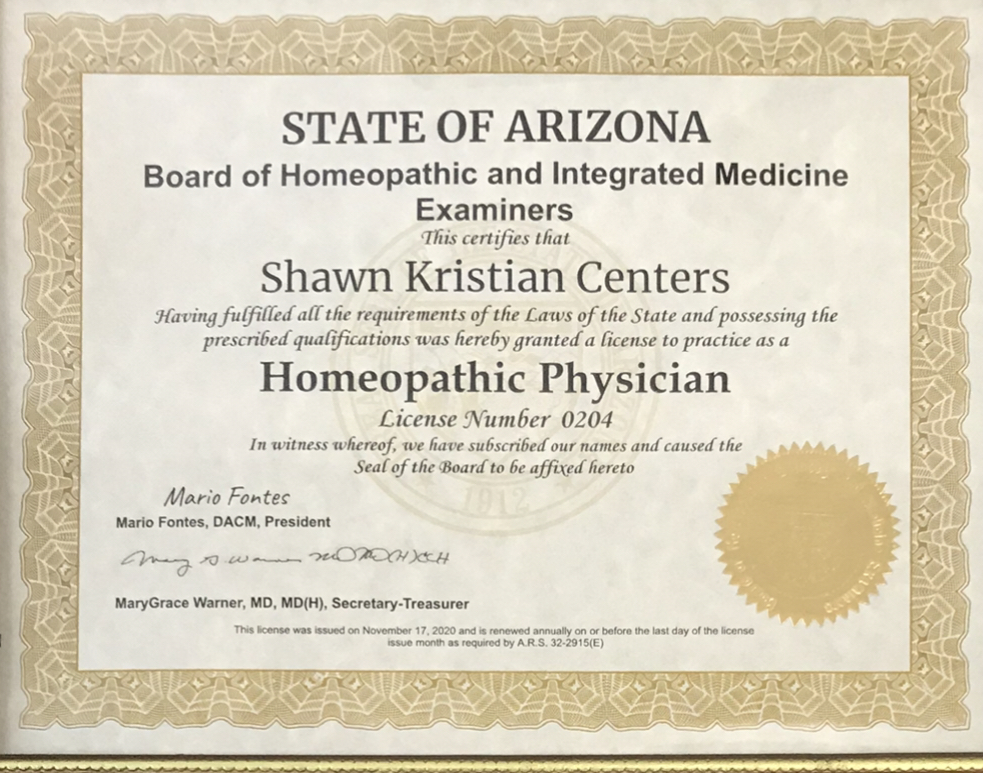
Dr. Centers is licensed in Arizona as an MD(H)/DO(H) — a Homeopathic and Integrative Physician. By choice, he does not hold D.O. licensure and does not represent himself as an osteopathic physician. Dr Centers completed a Fellowship in Osteopathic Princples and Practice and graduated with Doctor of Osteopathic Medicine Degree but is licensed by the Arizona Homepopathic and Integrated Medicine Board and is therefore a Arizona licensed Doctor of Osteopathic Medicine (Homeopathic).
The MD(H)/DO(H) is an advanced credential held by physicians who have trained beyond conventional training to integrate broader therapeutic approaches. Under Arizona law, it carries full physician authority — including prescribing medications, ordering laboratory tests, and performing manipulative therapy. For more information about Homeopathic Physicians in Arizona contact The Arizona Homeopathic and Integrative Medical Association, Homeopathic and Integrated physicians are considered licencesd physicians in the state of Arizona and may prescribe, dispense, or administer medications, including pharmaceuticals, order lab tests, imaging studies, and perform manual manipulation where appropriately trained.